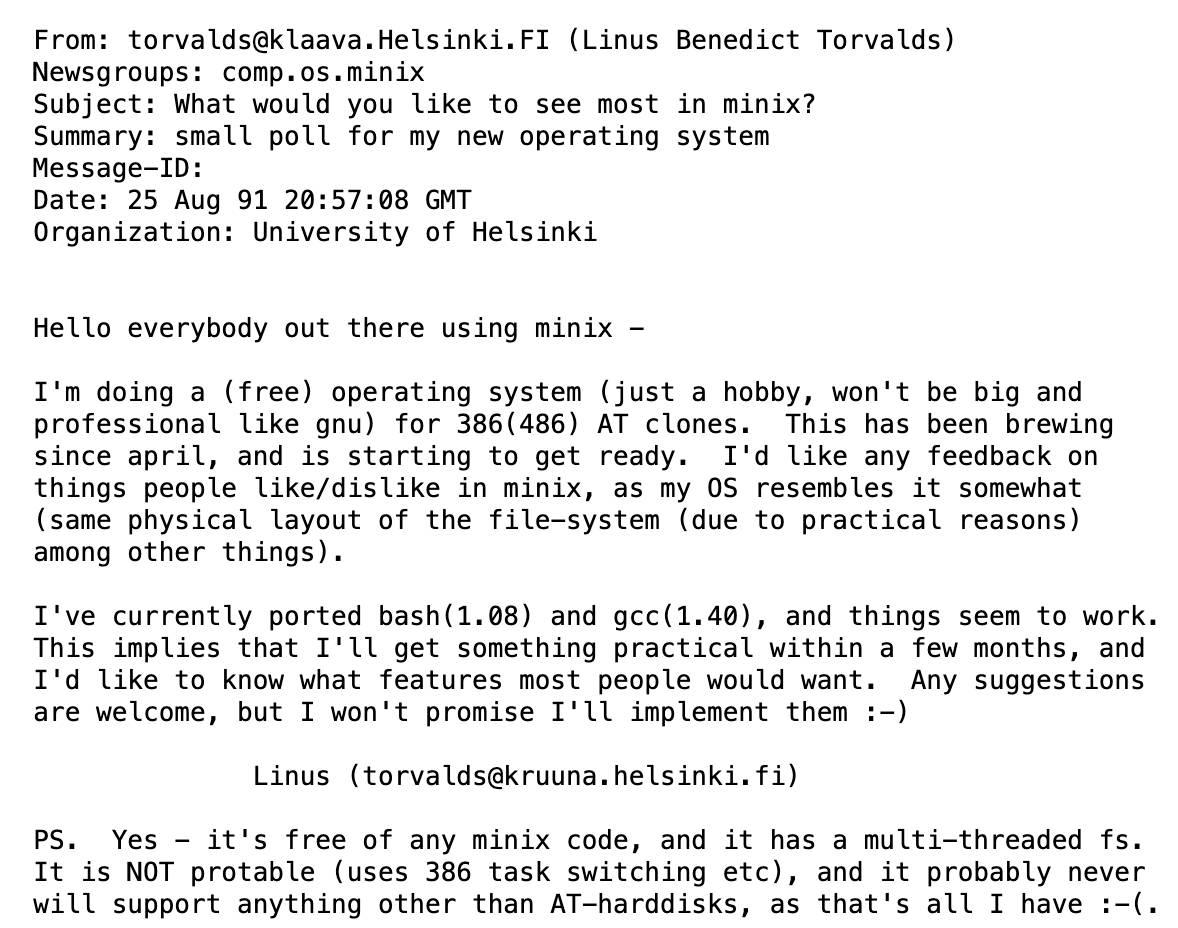
Just look at those nested parentheses. A true sign of (pedantic) greatness, when a person needs to clarify something in their earlier clarification.
I love it™ (The nested parentheses are one of the greatest tools known to mankind (And to all other creatures))
To paraphrase an old tweet: “parentheses - for when every thought comes with bonus sub-thoughts”.
Jfc im older than Linux
There’s no guessing what will catch the world by storm. At a party once, Bram Cohen tried to get me interested in his ideas for a a peer-to-peer protocol, and I thought nothing of it.
(just a hobby, won’t be big and professional like gnu)
Aged like fine milk. Looking at you, GNU Hurd.
Happy Birthday!
Funny how he made it basically for his desktop computer.
33 years later, and Linux is dominating in every part of the OS world except … the desktop.
(I’m paraphrasing his quote – he said something like this years ago, can’t find it, though.)
(Edit: to be more fair with quotes, it might be the case that I “hallucinated” the quote. he might not have said that, or he might have just said part of it and other part would be someone else’s comment. This cio.com article is probably a better source on his position )
I’m OOTL, what’s the backstory here?
Linux
What was minix then? A non FOSS version?
https://www.linuxjournal.com/article/10754
MINIX originally was developed in 1987 by Andrew S. Tanenbaum as a teaching tool for his textbook Operating Systems Design and Implementation. Today, it is a text-oriented operating system with a kernel of less than 6,000 lines of code. MINIX’s largest claim to fame is as an example of a microkernel, in which each device driver runs as an isolated user-mode process—a structure that not only increases security but also reliability, because it means a bug in a driver cannot bring down the entire system.
In its heyday during the early 1990s, MINIX was popular among hobbyists and developers because of its inexpensive proprietary license. However, by the time it was licensed under a BSD-style license in 2000, MINIX had been overshadowed by other free-licensed operating systems.
Today, MINIX is best known as a footnote in GNU/Linux history. It inspired Linus Torvalds to develop Linux, and some of his early work was written on MINIX. Probably too, Torvalds’ early decision to support the MINIX filesystem is responsible for the Linux kernel’s support of almost every filesystem imaginable.
Later, Torvalds and Tanenbaum had a frank e-mail debate about the relative merits of macrokernels (sic) and microkernels. This early history resurfaced in 2004 when Kenneth Brown of the Alexis de Tocqueville Institution prepared a book alleging that Torvalds borrowed code from MINIX—a charge that Tanenbaum, among others, so comprehensively debunked, and the book was never actually published (see Resources).
See also: https://en.wikipedia.org/wiki/Tanenbaum–Torvalds_debate
What was minix then? A non FOSS version?
It wasn’t FOSS, but then neither was Linux originally.